Comparison
BeefyGuard vs Rose, Shieldy, Combot and Safeguard
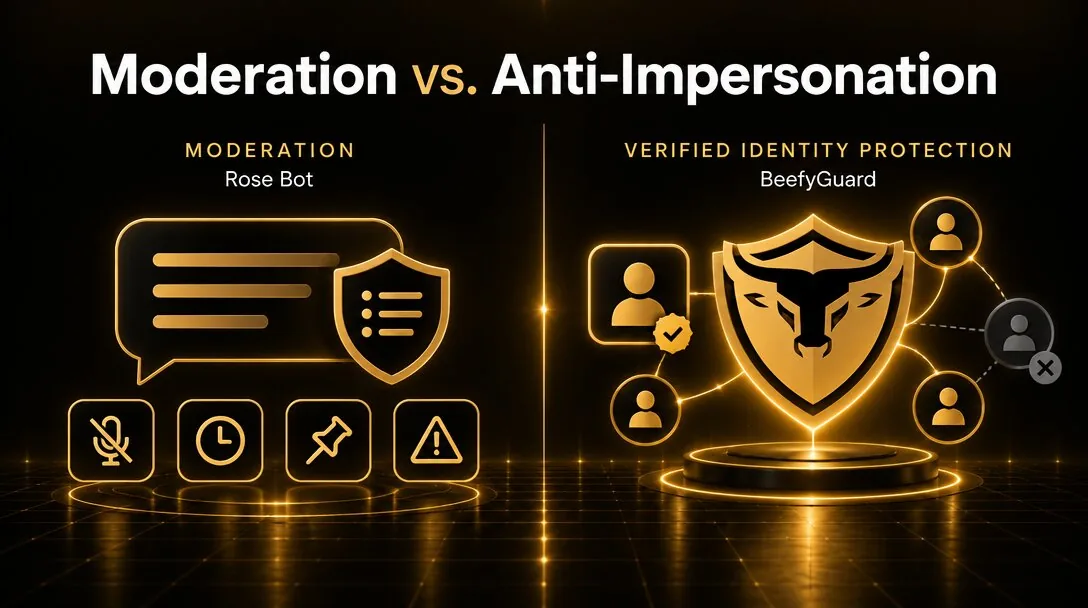
These tools solve different jobs. Rose and Combot document broad moderation. Shieldy documents join CAPTCHA. Safeguard documents Portal verification and spam controls. BeefyGuard documents admin impersonation detection plus Portals. Use the table to match the job, not to crown a single winner.
Last checked: October 2026. Unknown public claims are marked Not documented.
Feature table
| Feature | BeefyGuard | Miss Rose | Shieldy | Combot | Safeguard |
|---|---|---|---|---|---|
| Primary documented focus | Admin impersonation + Portals | Group moderation | Join CAPTCHA / anti-spam | Moderation, analytics, CAS | Portal verification + group security (+ buy bot) |
| Join CAPTCHA | Yes (Portal verification) | Yes (docs: button/text/math modes; join-request flow) | Yes (core: digits/math/button challenges) | Yes (site lists captcha in moderation) | Yes (join captcha + Portal docs) |
| Public entry → private group portal | Yes (Portals; Multi-Portals for multiple private chats) | Partial (join-request + CAPTCHA flow documented) | Not documented | Not documented | Yes (public channel portal + private group guidance) |
| One-time invite after verification | Yes | Not documented | Not documented | Not documented | Not documented |
| Admin display-name / lookalike detection | Yes (core) | Not documented as automatic admin-clone detection | Not documented | Not documented | Not documented |
| Admin profile-photo clone detection | Yes (core) | Not documented | Not documented | Not documented | Not documented |
| Chat locks / antiflood / filters | Secondary modules available | Yes (locks, blocklists, filters, antiflood, anti-raid) | Limited (entry focus; channel-link and under-attack options) | Yes (moderation, spam filters, mass removal) | Yes (anti-raid, flood control, scam blocker docs) |
| Shared spam ban network (CAS or similar) | Yes (CAS integration documented on BeefyGuard features) | Not documented on Miss Rose getting-started overview | Yes (optional CAS toggle in Shieldy config) | Yes (CAS; free and open to third-party bots) | Not documented as CAS |
| Web dashboard for settings | Yes | Not documented as primary (command-oriented docs) | Not documented | Yes (combot.org account / settings) | Not documented in detail on public intro pages |
| Open-source bot code | Not documented | Not documented | Yes (GitHub: 1inch/shieldy) | Not documented | Not documented |
How to read this fairly
- Moderation first. If your pain is locks, floods, and filters, start with Rose or Combot docs and keep what already works.
- Entry next. If bots flood joins, Shieldy-style CAPTCHA or a Portal product is the right lane.
- Identity last mile. If members report fake admin DMs, you need display-name and profile-photo checks against real staff. That is BeefyGuard's documented core.
- Stacking is normal. Crypto groups often run a moderation bot and an anti-impersonation bot together.
BeefyGuard facts used here
- Detects admin display-name and profile-photo impersonation in Telegram groups
- Portals: CAPTCHA from a public @, one-time invite that expires on use, optional Multi-Portals into multiple private chats
- Web dashboard for configuration
- Pricing is group-size based, shown after Telegram login, payable in USDT, USDC, or ETH
Details: features, pricing, Portals, Multi-Portals, best anti-scam bots guide.
Sources
FAQ
Should I replace Rose or Combot with BeefyGuard?
Often no. Rose and Combot are strong at chat moderation and related tooling. BeefyGuard’s documented core is admin impersonation detection and Portals. Many groups keep a moderation bot and add BeefyGuard for identity clones.
How is BeefyGuard different from Shieldy or Safeguard Portals?
Shieldy focuses on CAPTCHA for newcomers. Safeguard documents Portal verification into private groups plus broader spam controls and a buy bot. BeefyGuard Portals also gate private entry, and BeefyGuard additionally documents admin display-name and profile-photo impersonation detection.
Why do some cells say Not documented?
This page only states features found in each product’s public docs or official site as of the last-checked date. Absence from public docs is marked Not documented rather than assumed false.